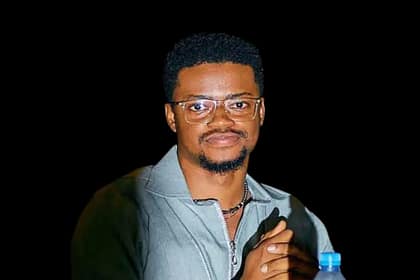
Across Nigeria, creativity often blooms quietly in places far from the glare of big-city spotlights, steered by individuals with sheer determination and vision. One such person is Jonathan Oluwatosin Onipe, a creative economy professional reshaping Gwagwalada’s cultural landscape, transforming words into instruments of healing, and building platforms where young creatives can thrive. With years of experience creating spaces for artistic expression and guiding emerging voices, his work demonstrates the capacity of art to spark social transformation.
For this edition of Portraits of the City, we spoke with Jonathan about his journey, his initiatives, and his deep connection to Gwagwalada.
Could you tell us more about Jonathan Onipe?
I’m a performance poet, cultural architect, and creative economy professional. My work sits at the intersection of art, culture, and social transformation. I believe poetry is more than words; it’s an instrument for healing, revolution, and building communities. Over the years, I’ve run a poetry organisation known as Absolute Poetry, under which I have organised two conventions, WAFFCON (Women in Arts, Film and Fashion Convention), and NIPCON (Nigeria International Poetry Convention), all platforms that use art to inspire change, nurture talent, and shape culture.
Let’s talk about your journey as a performance poet and creative economy professional. How did it all begin?
It began dramatically with a prayer and a toilet. I have always been a writer, but on March 16, 2013, I attended a workshop on discovering talent and purpose where the tutor asked us to pray to God to reveal our talent to us. I made this prayer and kept the words so close to my heart as I slept that night. Seemed like I kept Heaven on a redial with my action (keeping the words in my heart), God had to pick up the phone and granted me my request. He gave me my first poem the next day, March 17, 2013. Strange words started to come out from my lips, and I knew very well to write them down and that was it. As I grew, I realized that performance gave life to my writing, allowing me to speak healing, truth, and laughter into spaces. Over time, that love for poetry expanded into creating platforms where others could thrive, hence my dive into the creative economy. I started organizing workshops, managing events, and building spaces that gave young creatives access to training, visibility, and a sense of belonging.
What brought you to Gwagwalada, and how long have you lived here?
I came to Gwagwalada in 2007 when I was just 12. My family moved here, and at first, it felt like a small, quiet town on the edge of the city. But with time, it became home — a place that allowed me to grow, fail, rise again, and find my voice as an artist. So, I’ve lived here for close to two decades now.
How has living in Gwagwalada shaped your creative career?
Gwagwalada has this raw, unfiltered energy. It’s a mix of cultures, languages, everyday hustle, mental drag, and hungry days. Depending on where you choose to stand, Gwagwalada could be the reason you’re inspired or why you don’t get better as a creative person. Let’s just say there’s something about simplicity and chaos that pushes you to make meaning out of ordinary life here. To dream even when the environment doesn’t look like the dream. My Gwagwalada story will say creativity doesn’t need fancy; it just needs fire.
You are an active player in Gwagwalada’s creative community. What efforts have you undertaken to boost the community’s creative presence?
A lot of my work revolves around building platforms for expression. Through Absolute Poetry, I’ve run for three years the Open Mic Gwagwalada, a platform for all creatives that gives room for expression and growth. I’ve most recently taken the global TEDx program to Gwagwalada, and it has been a rollercoaster of everything.

What is your creative vision for Gwagwalada, and how does your work with TEDxGwagwalada tie into that vision?
My vision for Gwagwalada is to become a community of creatives who love the arts and are passionate about shifting culture, creating impact, and driving social change. With TEDxGwagwalada, I want to transform the minds of the people in Gwagwalada with ideas that I hope get into our streets, schools, and small corners. The long-term goal represents what I’ve always believed — that powerful ideas don’t just come from big cities; they can be born in quiet places too. TEDxGwagwalada is about reclaiming our narrative and showing the world the brilliance rooted here.
How does the everyday energy, culture, or struggles of Gwagwalada influence your poetry and storytelling?
Gwagwalada gives my poetry soul. I write about resilience, faith, laughter, and survival — all things you see every day here. The stories of market women, bike riders, students, artisans, street hawkers, beggars, and dreamers find their way into my lines. Even the heat and the many nights of utter darkness has in many ways made the thriving and growing artist that I am today.
What unique challenges have you faced working in the creative economy, and how have you navigated them?
Funding and visibility are two major challenges. Sometimes, you have the ideas and the passion, but not the financial or institutional support to scale them. I’ve learned to build slowly and stay consistent, and most recently, I’ve learnt to collaborate widely.
What are the little things about Gwagwalada that bring you joy?
The memories of street football.
Where in Gwagwalada feels most like home to you?
Honestly, any space filled with people I love or conversations that spark creativity feels like home.
What’s one unforgettable lesson Gwagwalada has taught you?
Gwagwalada taught me that growth can happen anywhere, even in places that people overlook. You don’t need to abandon your roots to bloom; sometimes, you just need to water them differently.
If Gwagwalada were a person you had to describe with a word or sentence, how would you describe it?
Gwagwalada would be that humble friend with big dreams not loud, not flashy, but always doing something quietly remarkable.
What are some of your favourite activities to do in Gwagwalada, and what are your favourite spots for these activities?
I love long walks. They help me think, observe, and write. I also enjoy hanging out at creative spaces or small cafés with friends, talking about ideas and art. I love street food too. Nothing beats a stopover at a Mai Shayi to eat two superpack imdomie and one egg.
In what ways do you feel Gwagwalada has shaped who you are right now? What parts of you would be different if you lived somewhere else?
Gwagwalada grounded me. It taught me patience, humility, and the art of starting small. If I’d grown up elsewhere, I might have been more focused on speed than substance. But here, I learned that impact takes time, that greatness can be quiet at first. I think living here made me more empathetic, intentional, and deeply connected to people’s stories.
If you could write a poem on/for Gwagwalada, what would it be?
It would be titled “The City That Raised Me”. A love letter to dusty roads, scorching heat, unbroken spirits, and unseen miracles. A poem that says:
“I see you, Gwagwalada.
You made me.
You taught me how to dream without permission, how to build from little, how to turn little into much.”
Portraits of the City is a Moveee series exploring the relationship people have with places and how these relationships affect their personal lives and careers. Do you have a story you would love to share? Get in touch with us today.